
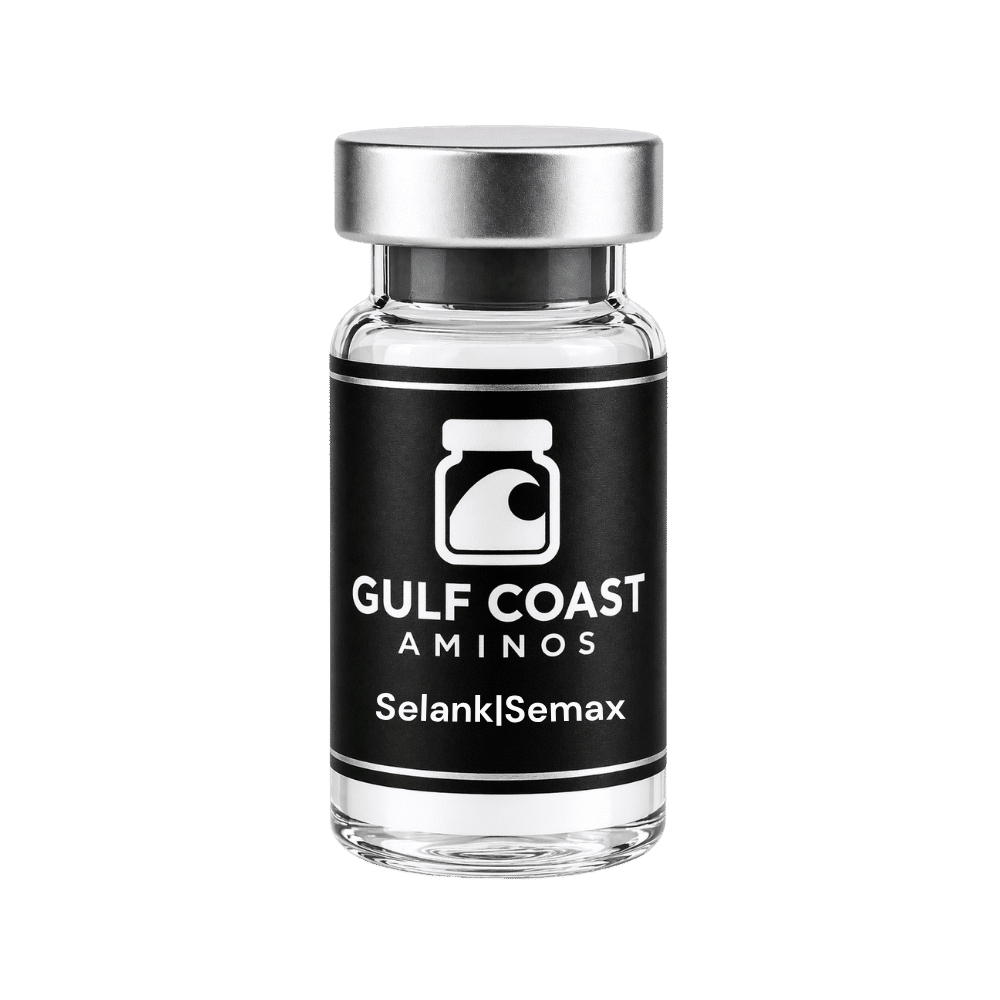
Selank 10mg + Semax 10mg Blend
Original price was: $59.95.$41.96Current price is: $41.96.
Selank + Semax Blend is a laboratory research formulation containing two synthetic linear heptapeptides. Selank (TKPRPGP) is structurally derived from the tuftsin tetrapeptide sequence with a C-terminal Pro-Gly-Pro extension, while Semax (MEHFPGP) contains the ACTH(4–7) sequence with the same C-terminal Pro-Gly-Pro motif.
Selank
- CAS: 129954-34-3
- Sequence: Thr-Lys-Pro-Arg-Pro-Gly-Pro (TKPRPGP)
- Molecular Formula: C₃₃H₅₇N₁₁O₉
- Molecular Weight: 751.9 Da
Semax
- CAS: 80714-61-0
- Sequence: Met-Glu-His-Phe-Pro-Gly-Pro (MEHFPGP)
- Molecular Formula: C₃₇H₅₁N₉O₁₀S
- Molecular Weight: 813.9 Da
Classification: Synthetic heptapeptide blend
Physical Form: Lyophilized research material
For Research Use Only. Not for human or veterinary use.
🔥 Exclusive Crypto Offer
Get an INSTANT 15% DISCOUNT when you pay with Bitcoin, Ethereum, Dogecoin, Bitcoin Cash, XRP, Solana, or USDT.
⚡ Don't have crypto? Buy it here in 5 minutes with easy guidance.
💡 Pro Tip: You can also pay with cryptocurrency using your verified Cash App or PayPal account for a fast and secure checkout!
Selank + Semax Research Blend
Selank + Semax is a two-component peptide research formulation containing the synthetic heptapeptides Selank and Semax. Both molecules are linear seven-residue peptides containing a C-terminal Pro-Gly-Pro (PGP) sequence while differing substantially in their N-terminal amino-acid composition and parent peptide relationship.
The formulation should be characterized as a mixture of two discrete molecular entities. Accordingly, each constituent retains its individual chemical identity and CAS Registry Number; the blend itself should not be represented as having a single CAS number.
Component 1 — Selank
Chemical Identity
- Common Name: Selank
- CAS Number: 129954-34-3
- PubChem CID: 11765600
- Sequence: Thr-Lys-Pro-Arg-Pro-Gly-Pro
- One-Letter Sequence: TKPRPGP
- Molecular Formula: C₃₃H₅₇N₁₁O₉
- Molecular Weight: 751.9 Da
- Peptide Length: 7 amino-acid residues
- Structural Class: Synthetic linear heptapeptide
Selank consists of the sequence Thr-Lys-Pro-Arg-Pro-Gly-Pro (TKPRPGP). Structurally, its N-terminal Thr-Lys-Pro-Arg sequence corresponds to the tetrapeptide tuftsin, followed by a C-terminal Pro-Gly-Pro sequence.
Component 2 — Semax
Chemical Identity
- Common Name: Semax
- CAS Number: 80714-61-0
- PubChem CID: 9811102
- Sequence: Met-Glu-His-Phe-Pro-Gly-Pro
- One-Letter Sequence: MEHFPGP
- Molecular Formula: C₃₇H₅₁N₉O₁₀S
- Molecular Weight: 813.9 Da
- Peptide Length: 7 amino-acid residues
- Structural Class: Synthetic linear heptapeptide
Semax consists of the sequence Met-Glu-His-Phe-Pro-Gly-Pro (MEHFPGP). Its N-terminal Met-Glu-His-Phe sequence corresponds to ACTH(4–7) and is extended at the C-terminus by Pro-Gly-Pro.
Structural Characteristics
Although Selank and Semax are chemically distinct peptides, both contain a Pro-Gly-Pro (PGP) C-terminal motif.
Selank:
Thr-Lys-Pro-Arg-Pro-Gly-Pro
TKPRPGP
Semax:
Met-Glu-His-Phe-Pro-Gly-Pro
MEHFPGP
The differing N-terminal residues produce distinct molecular compositions, while the shared PGP sequence represents a common structural feature of the two research peptides.
Semax additionally contains a methionine residue, accounting for the sulfur atom present in its molecular formula (C₃₇H₅₁N₉O₁₀S), whereas Selank contains no sulfur.
Laboratory Research Context
The individual peptides have been investigated in experimental systems involving peptide signaling, molecular and cellular response pathways, gene-expression changes, neuronal signaling, and biochemical characterization.
Semax has additionally been investigated in preclinical models involving ACTH-fragment-derived peptide biology. Selank has been investigated as a synthetic tuftsin-related peptide.
Research involving these compounds should distinguish between observations associated with each individual molecular component and observations obtained from the combined formulation.
Analytical Characterization
Appropriate analytical characterization of a Selank/Semax mixture may include techniques such as:
- High-performance liquid chromatography (HPLC)
- Liquid chromatography–mass spectrometry (LC-MS)
- Mass spectrometric identity analysis
- Peptide purity assessment
- Chromatographic retention profiling
- Stability and degradation analysis
Because the formulation contains two independent peptide species, analytical specifications should identify and quantify the individual components rather than characterize the material as a single molecular entity.
Storage & Handling
Lyophilized peptide material should be maintained under controlled laboratory storage conditions and protected from excessive heat, moisture, and direct light. Because Semax contains methionine, oxidative degradation should also be considered during analytical and stability studies.
Storage conditions should ultimately follow the specifications associated with the individual batch and applicable Certificate of Analysis.
Standard laboratory procedures and appropriate personal protective equipment should be employed when handling research material.
Research Use Only
This material is intended exclusively for laboratory research and analytical applications. It is not a drug, food, dietary supplement, cosmetic, or medical product. It is not intended for human or veterinary use, consumption, therapeutic administration, diagnosis, treatment, cure, or prevention of disease.
Only logged in customers who have purchased this product may leave a review.
Related products
Singles
Singles
Singles
Singles
Singles
Singles
Singles
Singles
Reviews
There are no reviews yet.